Retrieved article excerpt
Open article · Retrieved 2026-10-28T07:27:35.172774+00:00
GEAR
# GEAR: An Open General Evolutionary Architecture for Recursive Self-Improvement of LLM Agent Harness
Yehui Tang\*† 1Guanqi Zhu\* 2Shao-Jun Xia\* 3Xin Chen4Mengzhe Geng5Hongyang Du6Yuhao Tang1
1 Imperial College London2, 5 Independent Researcher3 Duke University4 The Chinese University of Hong Kong6 Brown University
\* Equal contribution · † Corresponding author
[Star on GitHub](https://github.com/rsi-gear/gear)[🤗Paper](https://huggingface.co/spaces/WizardTY/GEAR)arXiv Coming soon
GPT 5.6 Luna · performance & evolutionExpand figure ↗
GPT 5.6 Luna + DSH: Coding, Marketing and Support task pass rates for the baseline at medium effort, Gear at medium effort, and Gear at max effort. Marketing’s medium-effort pass rate progresses from 27 to 40 percent across evaluated harness rounds.
01 / The frameworkWithin tasks · Across tasks
## Learn from experience. Improve across tasks.
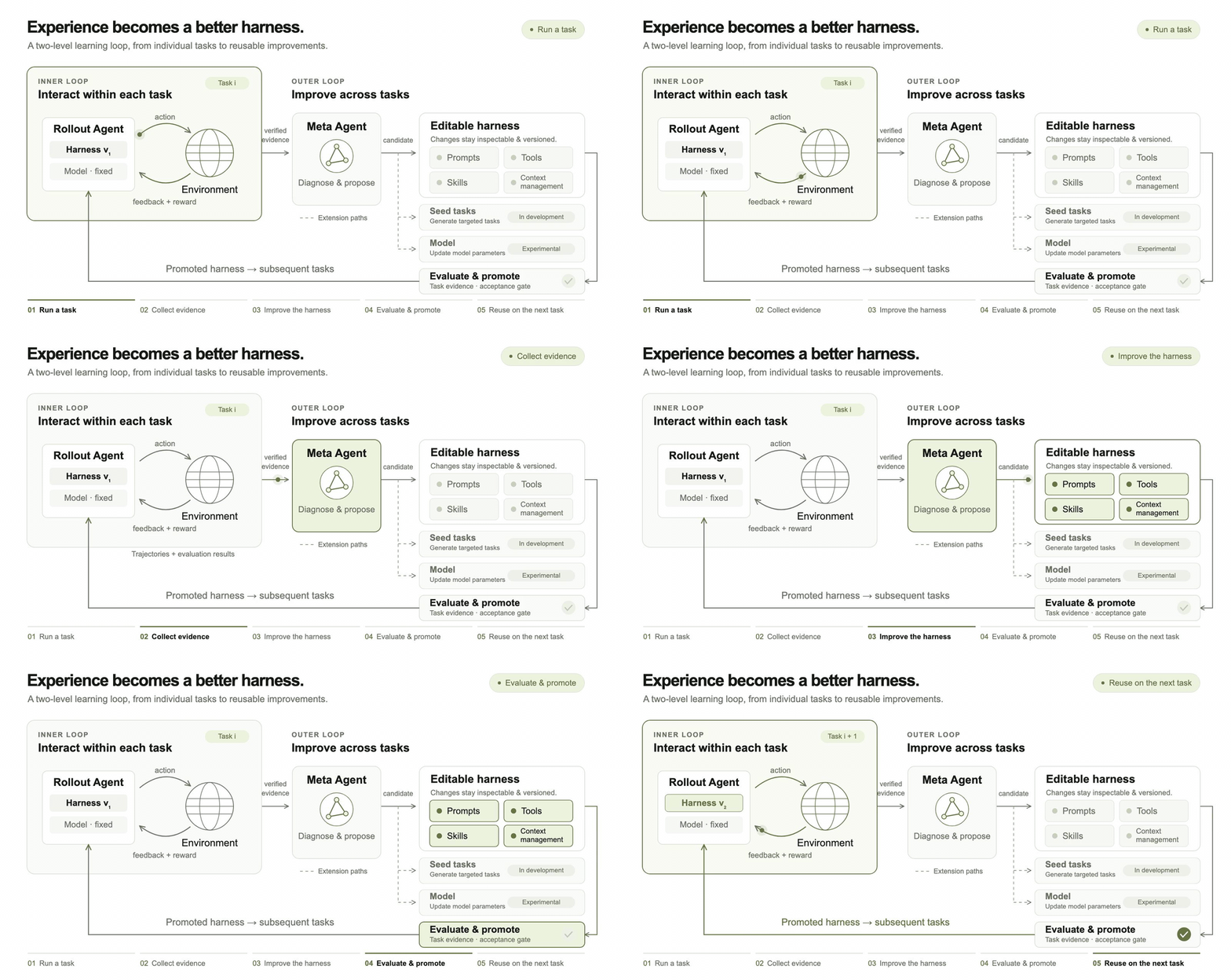
GEAR organizes recursive self-improvement as a **two-level meta-learning process.** In the **inner loop**, a rollout agent uses task feedback to refine its reasoning, planning, and actions within a task.
In the **outer loop**, a Meta Agent identifies common patterns across task experiences, including recurring failures and effective strategies, and proposes reusable improvements to enhance **cross-task performance.** GEAR evaluates and promotes these changes for subsequent tasks. The two loops can be optimized independently and are connected by experience.
The learning loop · within & across tasks
[GIF ↓](https://rsi-gear.github.io/assets/learning-loop.gif?v=20261023-promote)[Open video ↗](https://rsi-gear.github.io/assets/learning-loop.mp4?v=20261023-promote)
[](assets/learning-loop-poster.png?v=20261023-promote)](assets/learning-loop.mp4?v=20261023-promote)
Play↺ ReplayAnimation position0:00LOOP
01Task rollout02Evidence03Improve04Evaluate & promote05Next task
Animation could not load. Use the video or GIF link above.
02 / Evolutionary searchSearch, evaluate, retain
## Modular algorithms for evolutionary search.
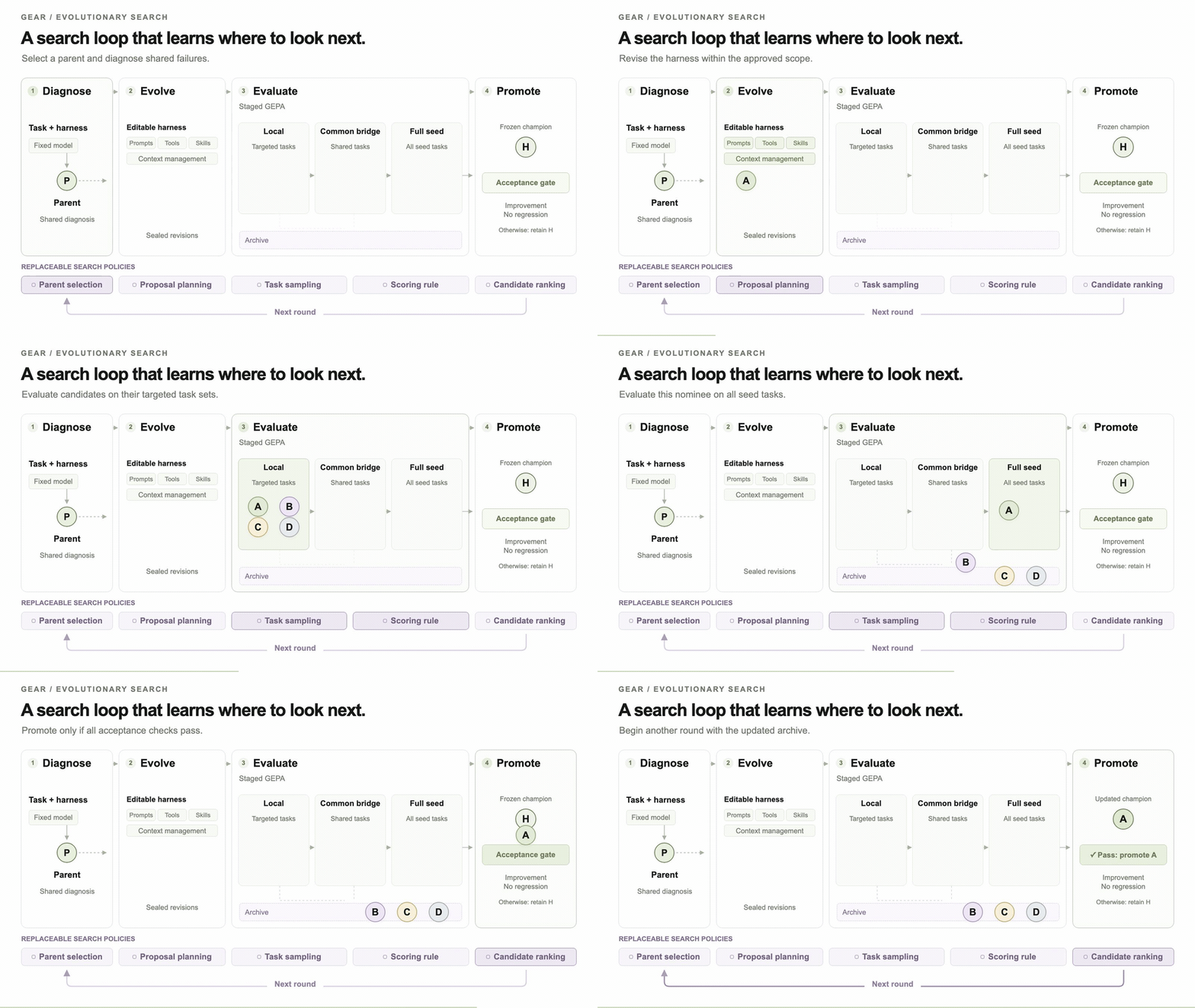
GEAR organizes evolutionary search into replaceable algorithm components,
providing a common framework for studying different search strategies.
Staged GEPA is one concrete instantiation, illustrated below.
Evolutionary search · Staged GEPA
[GIF ↓](https://rsi-gear.github.io/assets/evolutionary-search.gif)[Open video ↗](https://rsi-gear.github.io/assets/evolutionary-search.mp4)
[](assets/evolutionary-search-poster.png)](assets/evolutionary-search.mp4)
Play↺ ReplayAnimation position0:00LOOP
01Diagnose02Evolve03Local04Bridge05Full seed06Promote
Animation could not load. Use the video or GIF link above.
Replaceable policy modules
### Open the search, component by component.
Policy boundary
Parent selection
Proposal planning
Task sampling
Scoring rule
Candidate ranking
01 / Diagnose
#### Parent selection
Choose which archived harness to improve next. Staged GEPA uses task-level fronts to retain useful specialists and sample parents from the frozen archive.
Reads
: Frozen archive, champion, task-level evidence
Produces
: A parent harness for candidate generation
Editable harnessPrompts & policiesTools & hooksSkills & workflowsContext management
Policy modules express the framework’s design boundaries. The current staged implementation exposes parent selection as a public policy hook; evidence validation, evaluation stages, and final promotion remain controlled by the runtime.
03 / The resultsMeasured on real tasks
## Better harnesses. More completed tasks.
Improvements across coding, marketing, and support.
Same-model comparisons, with reasoning effort made explicit.
Marketing · task pass rate
27% → 40%
GPT 5.6 Luna · medium · DSH Base → Ours
Support · task pass rate
17% → 25%
GPT 5.6 Luna · medium · DSH Base → Ours
Coding · task pass rate
52.8% → 62.9%
GPT 5.6 Luna · medium · DSH Base → Ours
Full benchmark comparison +
Harness comparison · same model and reasoning effort within each group
| Agent | Harness | AutomationBench · Marketing ↑ | | AutomationBench · Support ↑ | | Terminal-Bench 2.1 ↑ |
| --- | --- | --- | --- | --- | --- | --- |
| Task pass rate | Obj. completion | Task pass rate | Obj. completion | Task pass rate |
| GPT 5.6 Luna medium | DSH (Base) | 27.0% | 75.4% | 17.0% | 72.9% | 52.8% |
| DSH (Ours) | 40.0% | 83.9% | 25.0% | 81.3% | 62.9% |
| Δ (pp) | +13.0 | +8.5 | +8.0 | +8.4 | +10.1 |
| GPT 6 Astra max | Codex | 57.0% | 84.1% | 35.0% | 88.4% | 86.7% |
| DSH (Ours) | 61.0% | 86.3% | 39.0% | 88.7% | 87.6% |
| Δ (pp) | +4.0 | +2.2 | +4.0 | +0.3 | +0.9 |
Δ is the absolute improvement in percentage points.
Additional evaluation · GPT 5.6 Luna (max) · DSH (Ours)
| Benchmark | Task pass rate | Objective completion |
| --- | --- | --- |
| AutomationBench · Marketing | 53.0% | 88.9% |
| AutomationBench · Support | 27.0% | 82.4% |
| Terminal-Bench 2.1 | 84.3% | — |
AutomationBench reports task pass rate and objective completion; Terminal-Bench 2.1 reports task pass rate. Luna max is a separate evaluation at a higher reasoning effort. [Result data ↗](https://rsi-gear.github.io/assets/paper-results.json)
04 / The research stackOne connected research stack
## Optimize. Execute. Understand.
Separate responsibilities, connected by versioned evidence.
GEAR × Hitch × RearExpand figure ↗
Gear diagnoses, evolves, evaluates and promotes candidate harnesses. Hitch versions and runs exact revisions and records evidence. Rear supports observation, inspection, comparison and annotation.
GEAR manages optimization; Hitch provides versioned execution and evidence; Rear supports inspection and annotation. The stack is designed to support a broader co-evolution research agenda.
Open researchInspect. Reproduce. Build.
## Explore GEAR.
Code, experiment records, and the tools to start your own research.
[01 / Source ↗
### Get the code
Explore the framework, search components, and examples.
github.com/rsi-gear/gear](https://github.com/rsi-gear/gear)[02 / Documentation ↗
### Run your first experiment
Set up a task benchmark and connect the Refine Skill.
Read the guide](https://rsigear.xyz/docs/gear)[03 / Experiment ↗
### Follow the search
Inspect the staged Marketing experiment and its evaluation evidence.
View the experiment](https://github.com/rsi-gear/gear/blob/main/docs/guide/en/example-algorithm.md)
05 / CitationReference the research
## Cite GEAR.
Preprint · October 2026. arXiv link will be added when available.
Copy BibTeX
```
@unpublished{tang2026gear,
title = {{GEAR}: An Open General Evolutionary Architecture for
Recursive Self-Improvement of {LLM} Agent Harness},
author = {Tang, Yehui and Zhu, Guanqi and Xia, Shao-Jun and
Chen, Xin and Geng, Mengzhe and Du, Hongyang and Tang, Yuhao},
year = {2026},
note = {Preprint},
url = {https://github.com/rsi-gear/gear}
}
```