2026-11-26 15:39 UTC

Lovable adds app-copy Drafts for parallel testing before publish

state: seedheat: mediumuncertainty: mediumrelevance: highlovable-drafts parallel-prototyping ai-app-buildersLovableObserve.AIOLX

What is this?

Lovable, an AI app-building platform, announced Drafts in a first-party post published November 20, 2026, and says users can try them now. A draft is a separate copy of a project, with its own chat and preview; the post says it can include a backend when needed. Users can test changes and example data in a draft, then accept changes and publish, or delete the draft. Lovable says draft test data stays separate and is cleared when the draft is accepted or deleted. The post includes testimonials from Observe.AI and OLX, which are company-reported examples rather than independent evaluation. Search results include an older, September-dated secondary article claiming drafts use the published database; that conflicts with Lovable’s account, and the supplied evidence does not resolve the discrepancy. The HN listing is dated November 18, earlier than the linked post’s publication date.

Why it matters

Drafts could make AI-built apps safer and easier to iterate on: teams can explore competing ideas, involve colleagues or clients, and test changes without immediately altering the live project. That lowers a practical barrier to experimentation as prompt-driven builders make app creation more accessible. The consequential detail is whether drafts truly isolate backend data and changes; Lovable says they can, but a secondary report raises a conflicting database-isolation claim that needs verification.

Current assessment

New: Lovable’s November 20 first-party announcement says Drafts are available now, allowing users to create multiple copies of an app, each with its own chat and preview, and to accept changes before publishing. Lovable says copies can include the backend when needed, are populated with example data, and keep test data out of real customer data; it also describes a revert option after accepting but before publishing. These are product claims, not independently verified findings. The post quotes an Observe.AI sales engineering director and an OLX product design and research director describing parallel exploration and testing; these testimonials suggest team use cases but do not establish broader adoption or outcomes. Search results also surface Lovable documentation describing draft copies for testing database changes, while a September-dated secondary article says drafts use the published database. Because that materially affects the safety claim and the evidence supplied does not reconcile it, database isolation should remain an open verification point. The HN timestamp precedes the official post’s publication date, so it should not be treated as confirmation of an earlier release.

Measured heat

now 0 pts/hpeak 8 pts/hcomments 0/hpeers p10momentum: steady2 platformsage 266h
points/hour across evidence · reading as of 2026-11-27 02:23:58.509736+11:00 · deterministic, not a model opinion

How the heat travelled

11-15 13:00⭐ origin echo-reconstructedLovable’s announcement says: “With drafts, you can copy your whole app, from design to database, as often as you like,” and that “Nothing go
Lovable on blog (echo) · attributed from hn.story.50531009
—
11-17 13:22first on hacker news · published · +48.4hLovable: Now you can explore any idea in parallel without touching what's live
doener
—
11-17 13:22amplified on hacker news 👑hn.story.50531009
doener
peak 36 · 30 comments · 100% of case engagement
11-20 17:21our radar first saw it · +124.3hdiscovery anchor: hn.story.50531009—
pace: p73 vs 2096 stories at the 168h mark (now 266h old) — ahead of auroraai-nanostories-dataset (1.0x), behind nvidia-nemotron-3-5-embed-1b-release (1.0x)

Evidence (2) — ⭐ canonical anchor

sourceobjectauthorscorecomments
🟧 hnLovable: Now you can explore any idea in parallel without touching what's live
Retrieved article excerpt

Open article · Retrieved 2026-11-20T17:22:07.642260+00:00

The best builders experiment, tinker, and tweak. Now you and your team can try different ideas in parallel and see how they'd really look in the wild before choosing your favorite, while your live app stays untouched.

With drafts, you can copy your whole app, from design to database, as often as you like. Each draft has its own chat and preview, so you and your team can work on separate versions and compare them side by side. Nothing goes live until you accept a draft and hit publish.

[![](https://assets.lovable.dev/content/news/introducing-drafts/drafts-overview-poster-2026-11-16.jpg)](https://assets.lovable.dev/content/news/introducing-drafts/drafts-overview-2026-11-16.mp4)
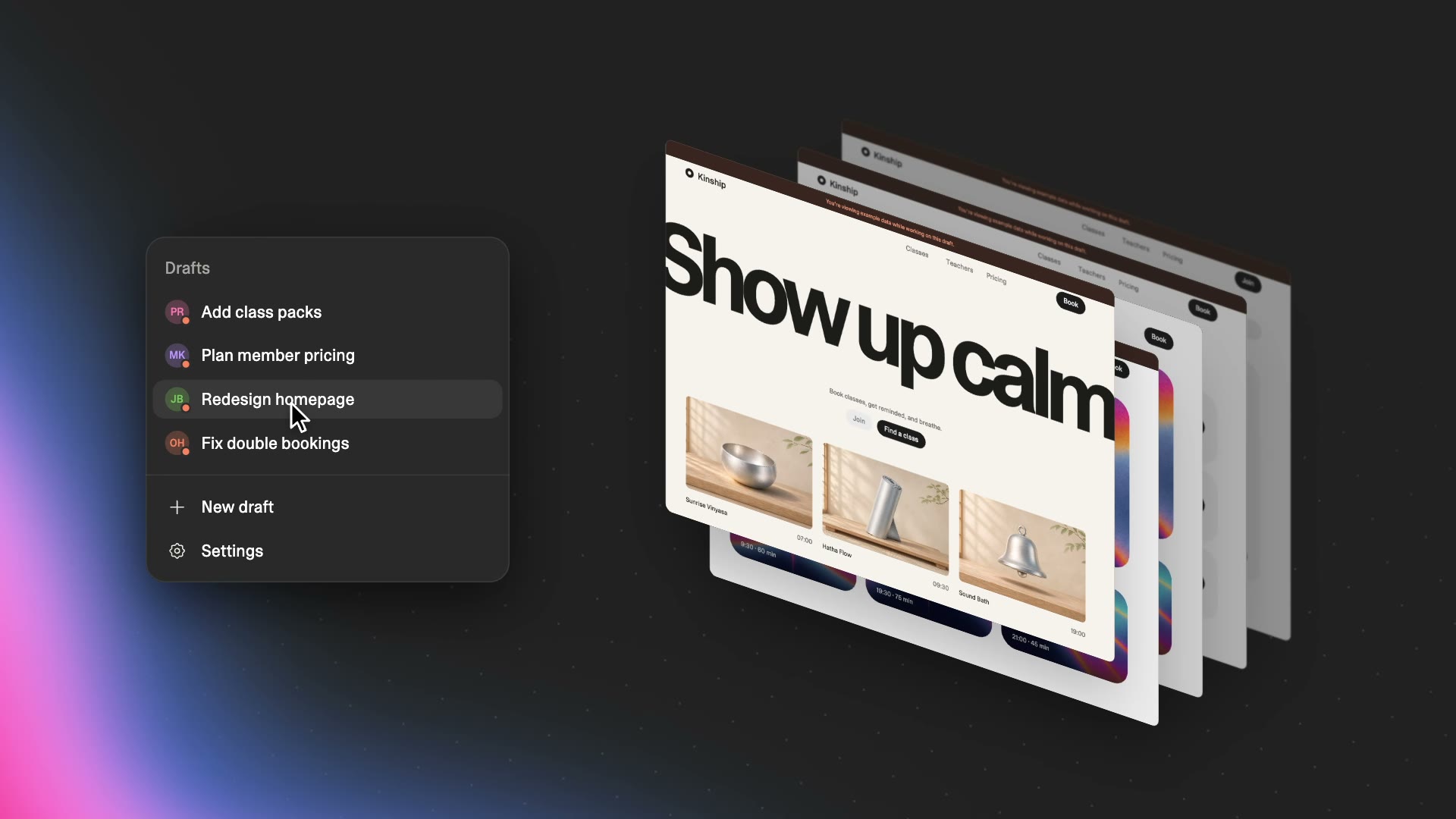
Here's what that means for you:

### Bring your people in without losing control

Let a teammate or a client make changes in their own draft without altering the existing app. Review each draft and choose which changes to keep.

> Our sales teams have been building their own tools with Lovable, from the Sales hub where we manage our sales pipeline to our demo library. Drafts let us try a few ideas at once and see how each one actually works with real-looking data, without risking the progress we've made or interrupting work in another part of the app.

**Jeremy Maher**, Director Sales Engineering, [Observe.AI](https://www.observe.ai/)

### Explore multiple ideas at once

Try out different ideas and keep what works. Every draft comes filled with example data, so instead of an empty page you see your idea with a busy booking calendar, a full order history, or a long list of sign-ups. You can even ask Lovable to spin up different versions for you and keep the ones you like.

### Make changes safely

Build and test changes on a full copy of your app, including its own backend when needed, before putting them in front of real customers. Try a new field on your sign-up form or a members-only page, without test entries landing next to real customer data.

> OLX runs online marketplaces across 7+ countries. We use drafts to test different features, layouts and UX side by side, then keep what works best. We can explore as much as we want without worrying about what's already live.

**Shane Stuart**, Director of Product Design & Research, [OLX Global](https://www.olxgroup.com/)

## Examples of what you can do

Now that each draft is a full copy of your app, backend included when needed, you can easily explore any new idea for your app, for example:

- A new field on your sign-up or booking form
- Who can see what, like a members-only page or an admin view
- A new dashboard, seen with months of example data
- New tables and records, without test entries landing next to real user data
- Deposits, a waitlist, or a new booking flow, visualized with a full example calendar
- Fresh layouts, images, videos, and sharper copy

## How it works

Open a project, click its name at the top of the editor, and hit "New draft." Lovable creates a complete copy of your app, from design to database. To edit the draft, just start prompting. You can create as many drafts as you like.

When you're happy with a draft, hit accept to add its changes to your project, then hit publish to make them live. Any data you add while testing stays in the draft and is cleared when you accept or delete it, so it never lands next to real customer data.

Changed your mind? Before you accept, just delete the draft. After you accept, you can still roll it back before you publish: open History, pick the version from before you accepted, and hit revert.

[**Try drafts now**](https://lovable.dev/)
doener3630
🟧 echo.blog ⭐Lovable’s announcement says: “With drafts, you can copy your whole app, from design to database, as often as you like,” and that “Nothing goLovable——

Interpretation history

Decision trace